



In This Article:
You just wrapped a brilliant tour. Your guests were laughing, asking questions, and taking photos at every stop. By the end, they were gushing about how much they loved it. And then they went home – and you never heard from them again.

Sound familiar? The gap between a guest who loved your tour and a guest who wrote a review is almost entirely a systems problem. It’s not about whether they liked you, it’s about whether you made it easy and natural to say so.
For tour operators today, learning how to ask for reviews isn’t optional. Nearly 9 in 10 travelers (93%) check online reviews before committing to a tour or activity booking. Volume matters enormously: a tour with 300 reviews will beat a tour with only 15 in most cases, even if the smaller competitor has a slightly higher rating. Reviews represent your strongest marketing lever – they’re proof your guests trusted you, and that proof compounds as you gather more. (For a deeper look at how social proof drives bookings, see Social Proof for Tour Operators.)
This guide walks you through exactly when to ask, how to ask, which platforms to prioritize, and how to build a review strategy that runs consistently without you having to think about it every time.
Why Reviews Matter for Tour Operators
In tourism, guests can’t test your experience before they buy it. They’re committing real money (and real vacation time) to something they can only imagine. Reviews bridge that gap. They’re the proof that your tour is worth booking.
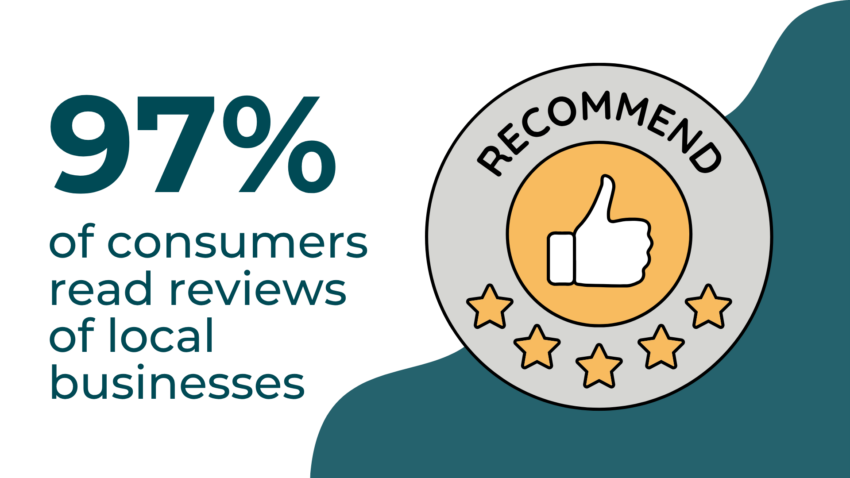
The numbers bear this out clearly. According to BrightLocal’s Local Consumer Review Survey, 77% of consumers “always” or “regularly” read reviews when browsing for local businesses, up from 60% in 2020. And 84% trust online reviews as much as personal recommendations. That means a stranger’s review on Google carries the same weight as a recommendation from a friend.
The impact on conversions is direct. ReviewTrackers research shows that consumers regularly filter out businesses with less than a 4-star rating. And in an A/B test on review visibility, adding a star summary to product pages increased revenue per session by 17%.
What this means practically: reviews aren’t just social proof, they’re conversion infrastructure. A steady stream of recent, high-quality reviews makes the difference between a traveler who books and one who scrolls past.
Review recency matters as much as volume. A burst of 50 reviews two years ago signals inactivity. Five new reviews this month signals a thriving business. Future guests want to know that other people are booking – and loving – your tours right now.
When to Ask for Reviews After a Tour
Timing is the single most important variable in your review strategy. Ask at the wrong moment and you’ll convert almost no one. Ask at the right moment and reviews come naturally.
The Peak-End Rule
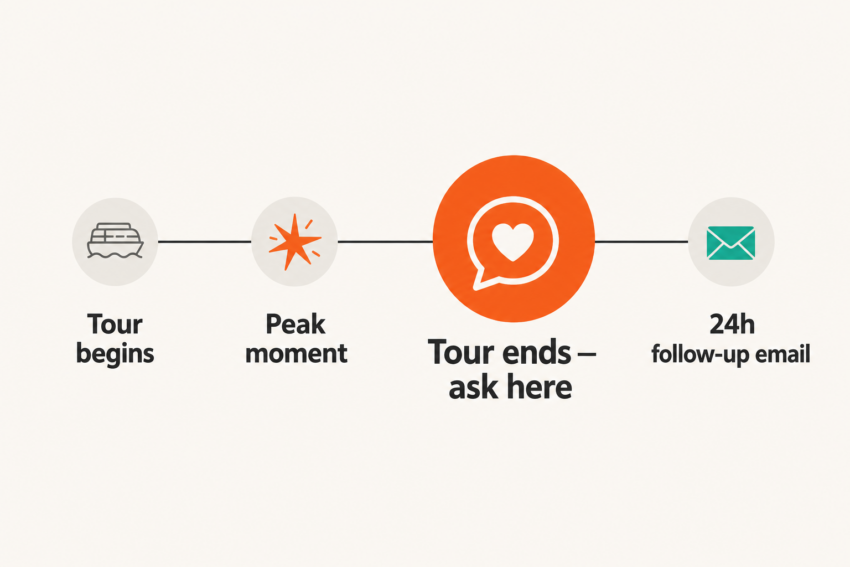
There’s a psychological principle called the peak-end rule: people’s memories of an experience are shaped primarily by how they felt at its emotional peak and how it ended, not by the average of every moment. Ending on a high note isn’t just a good idea, it’s what drives reviews, recommendations, and repeat visitors. For tour operators, this is critical. The emotional high at the end of a great tour is the moment your guests are most motivated to share.
That moment passes quickly. Life intervenes. Luggage gets picked up, dinner gets ordered, kids need attention. The guest who was effusive at 4 PM has moved on by 8 PM.
Ask during the tour’s closing moments, while the group is still together, energy is high, and the emotional peak is fresh. A guide’s genuine, conversational ask in those final minutes is the most effective review request you’ll ever make.
Here’s a script that works well: “If you had a great time today, we’d really appreciate a quick review on Google. It makes a huge difference for a small business like ours. If you scan this card, it takes you right there.”
And pay attention to that framing. It positions the request as authentic and beneficial to others, not as a sales pitch.
The 24–48 Hour Follow-Up Email
A follow-up email sent within 24 to 48 hours catches the guests who didn’t act on-site. The emotional peak has passed, but the memory is still vivid, especially if you reference specific details from their tour.
An email that opens with, “We hope you’re still thinking about yesterday’s whale watching adventure” dramatically outperforms a generic template. It re-anchors the guest to the specific memory you want them to write about.
Every completed tour should trigger a follow-up. This is where automation earns its keep – more on that below.
How to Ask for Reviews
The mechanics of how you ask matter as much as the timing. Here’s what actually works.
Train Your Guides to Ask Naturally

Your guides are your best review drivers. A guide who enthusiastically and authentically asks for reviews at tour’s end will generate far more than any automated email campaign. Why? Because guests trust people, not systems.
The key word is naturally. Guides shouldn’t sound like they’re reading from a script or apologizing for asking. They should sound like someone who’s proud of what they just delivered and genuinely wants to share it.
Train guides to integrate the review ask into their closing remarks as a standard part of the routine – not as an afterthought. Practice the language until it feels conversational. And consider tying guide performance to review generation: some operators run monthly leaderboards for reviews that mention guide names, with small bonuses or recognition for the top performers. It can take experimentation to find the right balance to incentivize reviews without encouraging pushiness, but once you find that balance, it pays off exponentially.
Use QR Codes to Remove All Friction
What stands between a satisfied guest and a written review? Almost always, friction. Guests finish your tour planning to write a review, then their attention shifts. The real solution isn’t pushing harder for reviews, it’s eliminating every possible barrier between that impulse to write and actually completing it.
QR-coded cards printed with your review link are one of the simplest, most overlooked levers in a review strategy.
Here’s why it works: guests can scan while they’re still standing at tour’s end, before heading off to their car. The code should jump them straight into the Google review-writing screen. Not to your homepage, not to your Maps listing, but directly into the form itself. Every additional step you add drops your completion rate noticeably.
Business cards with QR codes cost almost nothing to print, and Google provides an easy way to get the link you need most. Put your cards in guides’ hands. Include them in van seat pockets. Hand them out as guests disembark. The ROI on this investment is enormous.
Send Personalized Follow-Up Emails

For the guests who didn’t review on site, a well-crafted follow-up email is your second chance. Personalization is the load-bearing element to a successful followup.
Subject line approaches that drive opens:
- “We hope you’re still smiling after yesterday”
- “Help others discover [Tour Name]”
- “[Guest Name], we’d love to hear what you thought”
A template that works:
“Hi [Guest Name],
We hope you’re still thinking about [specific tour – e.g., the morning whale watch]. Your guide [Guide Name] loved having you along, and we’d genuinely appreciate it if you’d take 2 minutes to share your experience.
A few positive reviews help other travelers like you discover us. You can leave one right here: [direct link to review form]
Thanks for making our day unforgettable.
[Your name]”
The key elements: reference the specific tour and guide, re-anchor to the emotional memory, frame it as helping others (not yourself), emphasize that it only takes 2 minutes, and include one clear deep link. Don’t give them three platform options and let them choose – pick your primary platform and link directly to it.
Top Review Platforms for Tour Operators
Not all platforms are equal. Where you focus your energy matters.
Google Reviews (Your Top Priority)
Google reviews should be the primary focus of your review strategy, full stop. They directly influence your local search rankings, appear in Google Maps, and are the first thing most potential guests see when they search for your business. According to Moz, review signals account for 13% of the factors in Google’s local search algorithm, and 73% of all reviews across platforms come from Google.
When you drive someone to leave a review, default to Google unless you have a specific reason to do otherwise. Google reviews work for your business across every channel – they improve your organic visibility, your Maps presence, and your conversion rate on your own website. Rezgo’s guide on using Google Business Profile to drive local bookings covers how to set up and optimize your listing for maximum visibility.
TripAdvisor (Know the Risks)
TripAdvisor remains important for discovery, particularly for international travelers and those browsing OTAs. But before you build your entire review strategy around it, understand what you’re signing up for.
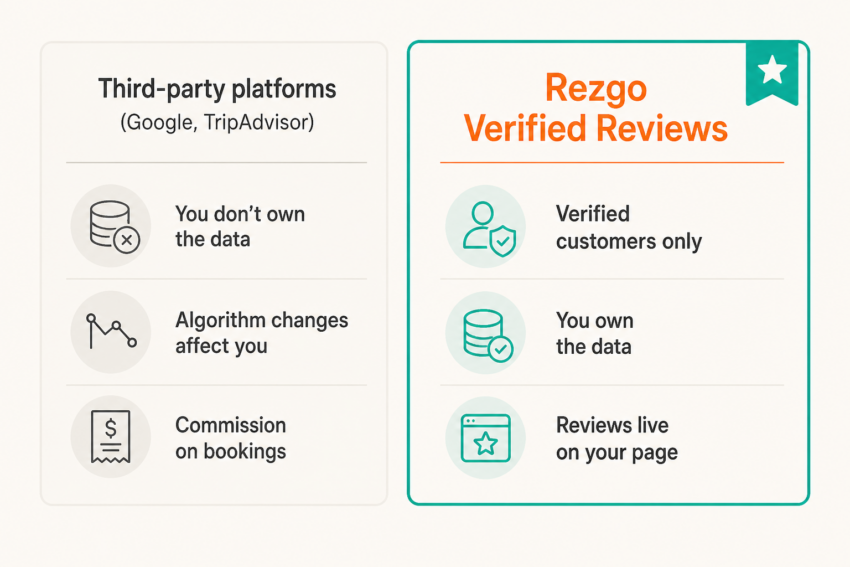
TripAdvisor owns Viator, the company that operates one of the world’s largest OTA platforms. When guests visit TripAdvisor to read your reviews, they’re also served with options to book through Viator rather than directly with you. Every booking that goes through an OTA costs you a commission and weakens your direct booking channel.
Beyond the competitive dynamic, there are operational risks: TripAdvisor’s review filtering is opaque. Reviews that operators believe are legitimate sometimes disappear without explanation. And TripAdvisor reviews don’t meaningfully improve your own website’s search rankings the way Google reviews do – the SEO benefit stays on their platform, not yours.
The right approach: Treat TripAdvisor as part of a diversified review portfolio, not as your anchor. Build your primary strength on Google, then maintain a presence on TripAdvisor for discovery purposes. This makes you less vulnerable to platform changes and less dependent on a company whose interests don’t fully align with yours.
Platform-Specific Reviews
If you distribute your inventory through Viator, GetYourGuide, Klook, or Booking.com, reviews on those platforms matter specifically within those booking channels. (If you’re working to improve your standing on OTAs, Rezgo’s post on boosting OTA rankings to get more bookings is worth a read.) Guests who find you through Viator look at your Viator reviews. Focus platform-specific review generation in proportion to where your actual bookings come from – don’t spread yourself across 10 platforms and underperform on all of them.
Rezgo Verified Reviews: Reviews You Actually Own
There’s a fourth option that most operators overlook: building your review presence directly on your own booking platform.

Rezgo’s built-in verified review system lets you collect and display reviews exclusively from guests who have actually completed bookings through your platform. Because review requests are tied to real bookings, you get only verified customers – no fake reviews, no anonymous submissions, no review manipulation. Operators have full control: you can reply to reviews, hide inappropriate content if needed, and manage the entire review process within your Rezgo dashboard.

The core difference from third-party platforms: you own the data. Your reviews live in your Rezgo ecosystem, displayed on your booking page where guests are already in the decision-making moment. There’s no algorithm filtering your reviews out, no platform changing policies that affect your visibility, and no competitor benefiting from your hard-won reputation.
For direct bookings specifically, Rezgo verified reviews put social proof exactly where it matters most – at the point where a guest is deciding whether to book.
Common Mistakes Tour Operators Make When Asking for Reviews
Even operators who understand the importance of reviews often undermine their own strategy with these avoidable errors.
Asking too late. The most common mistake. A review request sent three days after a tour competes with a dozen other memories. Ask during the tour, then follow up within 24 hours.
Making the process complicated. Sending guests to your homepage, asking them to find your Google Business Profile, search for the reviews tab, and then click “Write a Review” is asking too much. Deep link directly to the review form. Every click you add reduces your conversion rate.
Sending impersonal, generic emails. “Dear Guest, we hope you enjoyed your tour. Please leave us a review.” Nobody writes a review after reading that. Reference the specific tour, the guide by name, a memorable moment from the experience. Make the email feel like it came from a person.
Offering incentives that violate platform policies. Discounts, free upgrades, and cash rewards in exchange for reviews violate Google’s and TripAdvisor’s terms of service and can get your listing penalized or removed. Incentivize your guides to ask for reviews – not guests to write them.
Ignoring negative reviews. Potential guests pay close attention not just to what reviewers say, but to how the operator responds. 89% of consumers report they’re more likely to book with a business that replies to reviews, regardless of whether those reviews are positive or negative. When you answer a tough review thoughtfully and without defensiveness, you signal that you genuinely care about feedback-and you’ll often win more bookings from that response than from the five-star reviews sitting beside it.
Failing to build a repeatable system. A burst of review requests around peak season followed by months of silence creates gaps that signal inactivity. Every completed tour should automatically trigger a follow-up. Set it up once and let it run. For a full breakdown of where reviews fit in your broader guest management strategy, see How to Take Control of Your Guest Reviews.
Build Your Review System Today
The operators who consistently outrank their competition on Google, fill their tours through direct bookings, and maintain strong reputations aren’t doing anything magical. They’ve built a simple, repeatable system that works whether they’re thinking about it or not.
Here’s what that system looks like in practice:
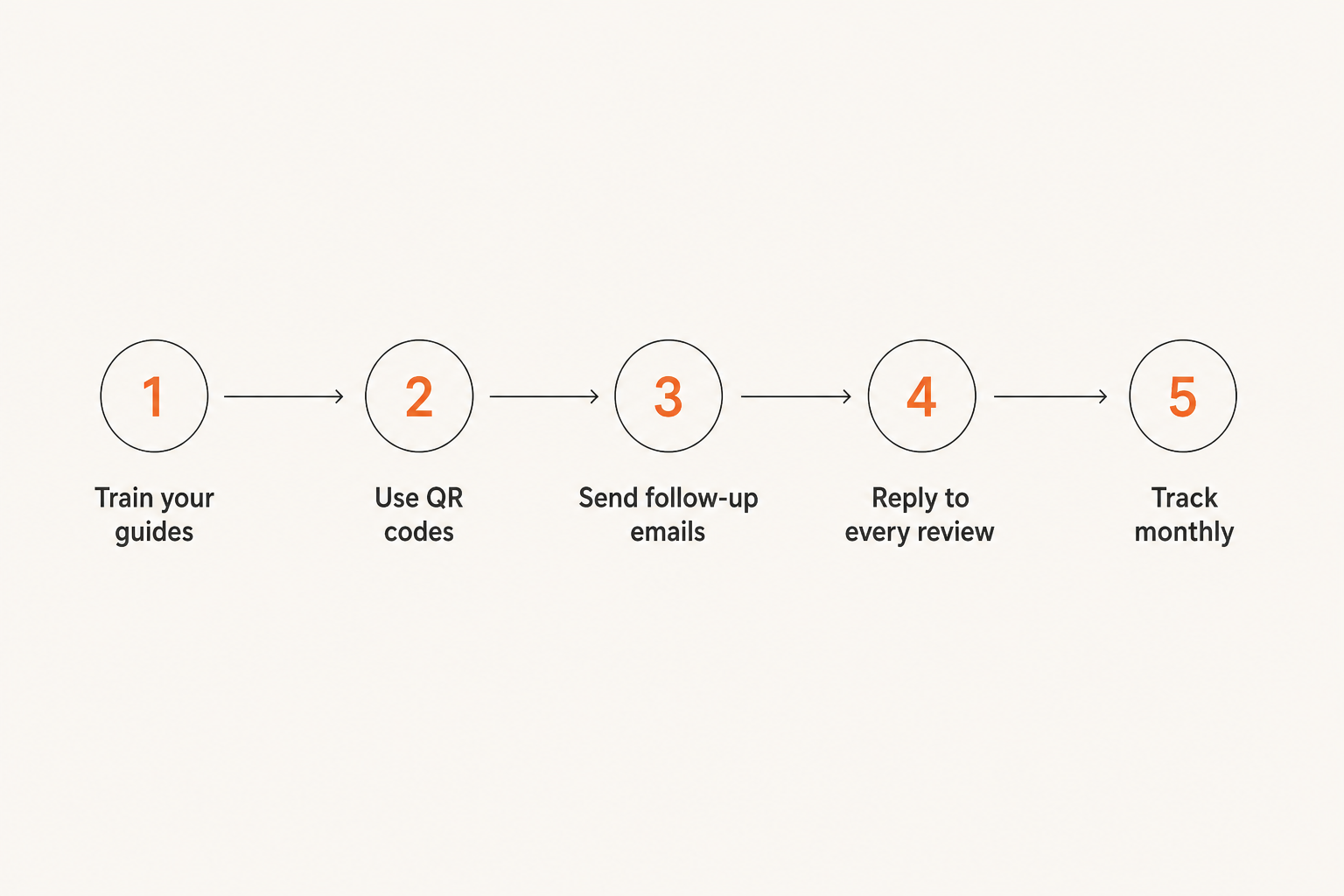
- Train your guides to ask naturally at tour’s end – every time, not just when they remember.
- Hand out QR code cards at the close of every tour, deep-linked to your Google review form.
- Automate a follow-up email to go out within 24 hours of tour completion, personalized with the tour name and guide.
- Reply to every review – positive and negative – within a week. This signals to future guests that you’re engaged and that you care.
- Track your review growth monthly so you can see what’s working and adjust.
The fourth item on that list – owning the data and having a permanent review presence on your direct booking page – is where Rezgo’s verified review system pays particular dividends. While your Google reviews improve your search visibility, your Rezgo reviews convert browsers into bookers at the exact moment they’re ready to commit.
Try Rezgo’s Verified Review System
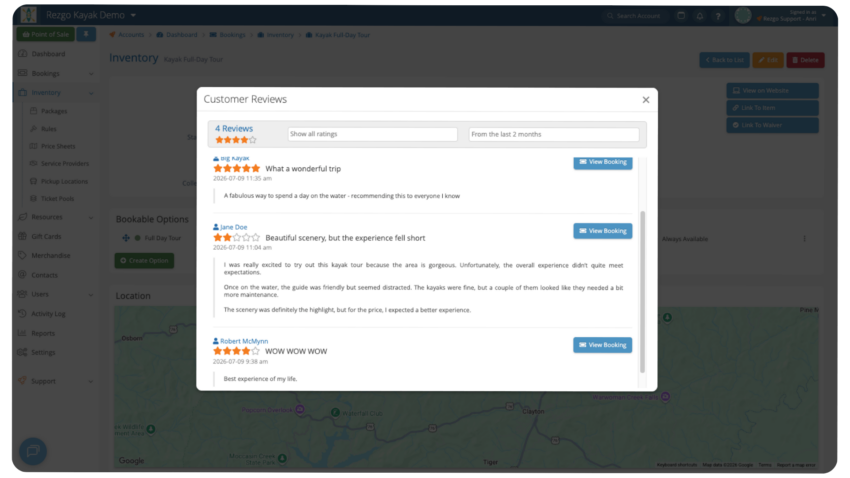
Rezgo’s verified review system is built into the platform – no extra setup, no third-party integrations, no platform risk. Every review comes from a guest who actually completed a booking, automated prompts go out on your schedule, and all replies and management happen in one place.
Combined with automated booking confirmations, customer messaging, and direct booking tools, Rezgo gives you everything you need to build a review strategy that runs while you focus on delivering great experiences.
Start collecting verified reviews with Rezgo →

Written By | Rahul Collins


Search The Blog
Categories
Most Popular Articles
- 16 Innovative Tourism Business Ideas and Trends for 2026
- Luxury Travel: 6 Key Trends That Are Dominating the Market
- Your Tourism Marketing Mix: the 7 Ps of Travel and Activity Marketing
- Global travel trends 2026: What tour and activity operators need to know
- Tour product manager, service providers, and more in Rezgo 7.0